To calculate overtime pay in Pakistan, find the worker's ordinary hourly rate, then pay twice that rate for every hour worked beyond the legal limit. For factories, shops and offices the limit is 9 hours a day or 48 hours a week. So a worker on Rs 250 an hour earns Rs 500 for each overtime hour.
That is the basic rule for overtime calculation in Pakistan. The rest of this guide shows where the rule comes from, which pay counts in the "ordinary rate", how to avoid paying the same hour twice, and how to set it up in payroll so the numbers hold up when a labour inspector or an unhappy worker asks.
What is the legal overtime rate in Pakistan?
The legal overtime rate in Pakistan is double the ordinary rate of pay for most private-sector workers. Section 47 of the Factories Act, 1934 says a worker in a non-seasonal factory who works "for more than nine hours in any day or for more than forty-eight hours in any week" is entitled "to pay at the rate of twice his ordinary rate of pay". In a seasonal factory the weekly trigger is 50 hours.
Shops, offices and other commercial establishments follow the West Pakistan Shops and Establishments Ordinance, 1969. Section 8 sets the same 9 hours a day and 48 hours a week, and section 9 says overtime "shall be calculated at double the ordinary rate of wages".
A few groups sit outside these rules. WageIndicator's summary of Pakistani labour law notes that executive and managerial staff are excluded, and that the Railways Act allows a lower 1.25 multiplier.
Calculators from foreign software vendors often default to 1.5 times pay after 40 hours a week. That is a US rule. For Pakistani factories, shops and offices covered by the laws above, use 2 times pay after 9 hours a day or 48 hours a week.
Which law applies in your province?
Each province has its own factories and shops laws, so the law you follow depends on where the workplace is. The overtime rate is double in each of the laws below, but section numbers and some limits differ.
| Where | Factories | Shops and offices |
|---|---|---|
| Islamabad, Balochistan | Factories Act 1934, s.47 | Shops Ordinance 1969, s.8-9 |
| Punjab | Factories Act 1934 as amended in Punjab, s.47 | Punjab version of the 1969 Ordinance |
| Sindh | Sindh Factories Act 2015, s.68(1) | Sindh Shops and Commercial Establishments Act 2015 |
| Khyber Pakhtunkhwa | KP Factories Act 2013 | KP Shops and Establishments Act 2015 |
The Sindh section number comes from a Dawn article on overtime rules by an industrial relations professional, and the KP laws from WageIndicator's list.
Punjab employers should also watch the Punjab Labour Code 2026. It was enacted as Act IX of 2026 and received the Governor's assent on 10 February 2026, according to ABS & Co, which adds that the existing legal framework stays in force until the Code's notification is issued. The Express Tribune (9 November 2026) reports that workers now have legal recourse for non-payment of overtime under the Code. We cover the Code in more detail in our Punjab Labour Code 2026 guide.
What counts in the "ordinary rate of pay"?
The ordinary rate of pay is all the money a worker is owed under their contract, minus a short list of exclusions. The Factories Act explanation to section 47 defines it as "all remuneration capable of being expressed in terms of money" and leaves out:
- the value of house accommodation, light, water, medical attendance or another amenity;
- employer contributions to a pension or provident fund;
- travelling allowance or the value of a travel concession;
- gratuity, bonus or a share in profits.
In practice this means overtime is normally worked out on more than basic pay. Dawn's article reads the same definition as "one's gross salary". If your company calculates overtime on basic pay only, check it against this definition before an inspection or a worker complaint does it for you.
For piece-rate workers, section 47(3) lets the government fix a time rate equal to their average earnings, and that time rate is treated as their ordinary rate.
How do you calculate overtime pay step by step?
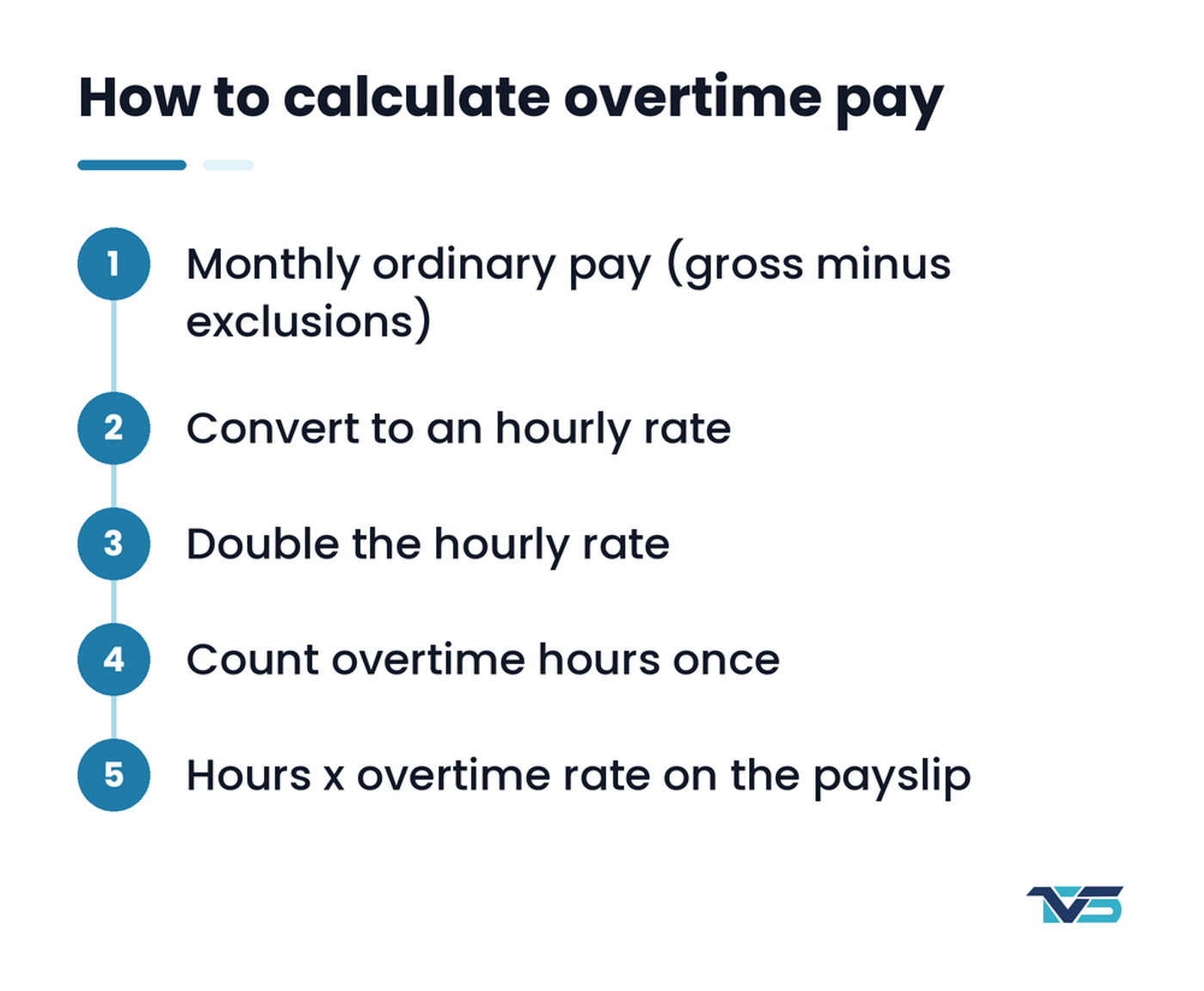
You calculate overtime pay by turning the monthly salary into an hourly rate, doubling it, and multiplying by the overtime hours. The law does not set one formula for the hourly rate, so pick a method, write it into your HR policy and use it for everyone.
- Work out the monthly ordinary pay. Gross pay minus the exclusions listed above.
- Turn it into an hourly rate. Two common methods: monthly pay x 12 / (52 x 48 hours), or monthly pay / 26 working days / 8 hours for a six-day, 48-hour week.
- Double it. That is the overtime rate per hour.
- Count the overtime hours. Hours beyond 9 in a day or 48 in the week, counted once (see the next section).
- Multiply and add to the payslip. Show overtime as its own earning line with the hours and rate.
A worked example
Take a machine operator with ordinary pay of Rs 52,000 a month on a six-day, 48-hour week.
| Step | Method A: x12 / (52 x 48) | Method B: / 26 / 8 |
|---|---|---|
| Hourly rate | 624,000 / 2,496 = Rs 250 | 52,000 / 26 / 8 = Rs 250 |
| Overtime rate | Rs 500 | Rs 500 |
| 10 overtime hours | Rs 5,000 | Rs 5,000 |
Both methods give the same answer here because the week is exactly 48 hours over 6 days. They drift apart for a five-day week or a 30-day divisor, which is why the method belongs in writing.
How do you avoid paying the same hour twice?
Count each overtime hour once, even when it breaks both the daily and the weekly limit. Section 47 is triggered by more than 9 hours a day or more than 48 hours a week, and a busy week can cross both.
Say a worker does 10 hours a day for six days, 60 hours in all. The daily rule gives 6 overtime hours (1 a day). The weekly rule gives 12 (60 minus 48). Adding them makes 18, which pays some hours twice. The practical approach most payroll teams use is to work out both figures and pay the larger one, here 12 hours. Put the rule you use in your HR policy and confirm it with your labour adviser.
Two other limits matter when you plan overtime:
- Spread-over. In a factory, work plus rest breaks may not spread over more than 12 hours in a day without the Chief Inspector's permission (section 38). Under the Shops Ordinance it is 10 hours in winter and 11 in summer (section 10).
- Annual cap for shops and offices. The 1969 Ordinance allows overtime only for stock-taking, making up accounts and similar operations, and caps an adult at 150 hours a year. Dawn reports the same 150-hour cap in Sindh's 2015 Act.
What about Sundays, rest days and public holidays?
Work on the weekly holiday needs a substitute day off as well as correct pay. Section 35 of the Factories Act lets a worker work on a Sunday only if they get a whole-day holiday within three days before or after it, the Inspector is notified and a notice is displayed. No substitution may leave anyone working more than ten days in a row. Section 35-A adds compensatory holidays where an exemption takes away a weekly holiday.
Rates for public holiday work vary by law and sector. For example, Dawn notes that a Sindh rule gives public utility workers on a public holiday either twice the ordinary rate or two compensatory holidays, at the worker's choice. Many companies also pay a higher multiplier on weekends and gazetted holidays by policy. That is allowed as long as it never falls below the legal double rate.
What records should you keep for overtime?
Keep a record of daily in and out times, approved overtime hours and the overtime paid to each worker. Section 47(4) lets the government prescribe overtime registers for factories, and Dawn notes that Sindh's factory rules require an overtime register. Good records protect you when a worker disputes a payslip.
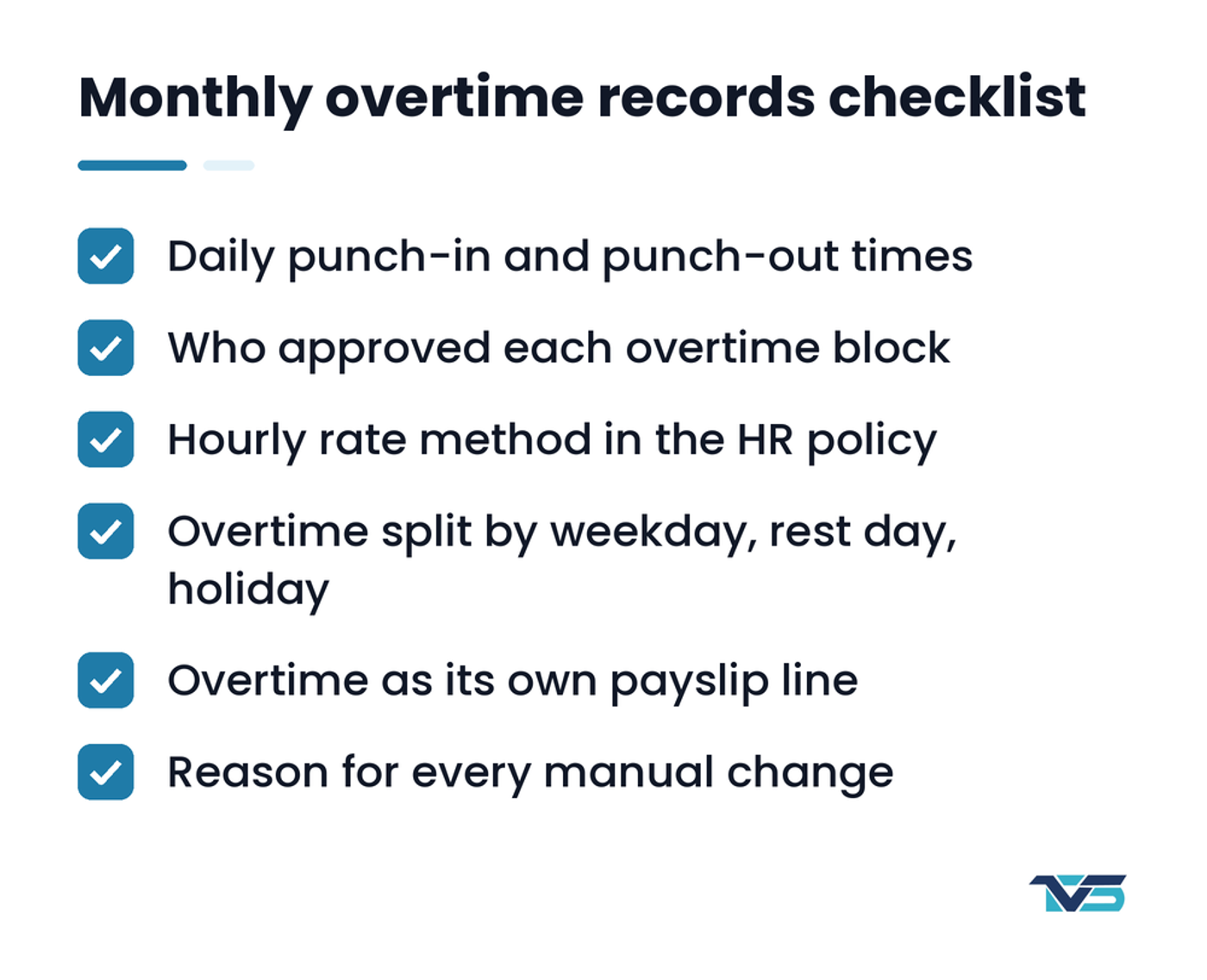
Use this checklist each month:
- daily punch-in and punch-out times for every worker;
- who approved each overtime block, and when;
- the hourly rate method written in your HR policy;
- overtime hours split by weekday, rest day and holiday;
- overtime shown as its own line on every payslip;
- any manual change, with the reason.
How can payroll software calculate overtime for you?
Payroll software calculates overtime from attendance, so nobody adds up hours from a register at month end. Solvix HCM is an HR and payroll system from Tech Vision Solvix for Pakistani businesses that turns biometric punches into daily attendance and pays approved overtime in the monthly payroll.
What it does for overtime:
- Punches in real time. Fingerprint, face, palm or card devices send punches to Solvix HCM as they happen, and each punch recalculates that employee's day. See our Attendance System and factory attendance system.
- Overtime minutes per day. Late, early-out, working and overtime minutes are worked out from the shift.
- Approval first. Overtime beyond the shift's grace buffer waits in a queue for an admin to approve, and only approved overtime is paid.
- Your multipliers. Separate weekday, weekend and public-holiday multipliers, set by you on basic or gross pay, so you can set the legal double rate. The per-day divisor can be 30 days, calendar days, 26 days or actual working days.
- Reports. An Overtime Details report shows paid and pending overtime by day type and multiplier.
Income tax on overtime is not calculated by the system; it is entered by hand. For choosing a system, read our payroll software guide, and for this year's tax and wage changes see payroll changes for 2026-27.
Frequently asked questions
Is overtime in Pakistan paid at 1.5 or 2 times?
For factory workers and employees of shops and commercial establishments, overtime is paid at 2 times the ordinary rate under the Factories Act 1934 and the Shops and Establishments Ordinance 1969 and their provincial versions. The 1.5 figure found on many online calculators is a US rule. Railways can pay 1.25 under the Railways Act.
After how many hours does overtime start in Pakistan?
Overtime starts after 9 hours in a day or 48 hours in a week for adult workers in non-seasonal factories, shops and offices. In seasonal factories the weekly trigger is 50 hours. Check your province's current law for any change.
Is overtime calculated on basic or gross salary?
The Factories Act defines the ordinary rate as all money remuneration under the contract, excluding items such as housing, provident fund contributions, travel allowance and bonuses. That usually means more than basic pay. Write the exact components you include into your HR policy.
Can an employer make overtime compulsory?
Yes, within the law. Section 47-A of the Factories Act says an adult worker may be required to work overtime as long as it follows the Act and its rules, including the daily spread-over and weekly holiday rules. The overtime must still be paid at the legal rate.
How should overtime appear on a salary slip?
Show overtime as a separate earning line with the number of hours and the rate, rather than folding it into gross pay. This makes it easy for the worker to check and gives you a record if the payment is ever disputed.
Overtime is easy to get wrong when it is added up from registers at month end. If you want attendance, overtime approval and payroll in one place, see Solvix HCM or book a demo with Tech Vision Solvix.