The Punjab Labour Code 2026 replaces more than two dozen older labour laws with one code for private employers in Punjab. To comply, employers need to put every worker on a written agreement in a language they understand, keep complete employment records, update leave policies (14 weeks of maternity leave and paid paternity leave), and answer written grievances within 15 days.
This guide is for owners and HR managers in Lahore, Faisalabad, Multan, Rawalpindi, Gujranwala, Sialkot and the rest of the province: what changes, what is still unclear, and what to do first.
What is the Punjab Labour Code 2026?
The Punjab Labour Code 2026 is Act IX of 2026, a single law that consolidates Punjab's private-sector labour laws. According to ABS & Co's legal alert, it received the Governor's assent on 10 February 2026 and abolishes the old "master and servant" approach to employment. WageIndicator describes it as replacing "a patchwork of more than two dozen outdated labour laws".
Coverage is wide. The Express Tribune (9 November 2026) reports that it protects workers in offices, shops, factories, households, construction, agriculture and digital platforms, and covers minimum wages, timely salary payment, working hours, overtime, leave, termination, discrimination and workplace safety.
Is the Code already in force?
The Code takes effect on the date the Punjab Government notifies in the official Gazette. Dunya News reported on 29 May 2026 that the government had notified the Code and that it now applies across the province. Some later summaries, including Pakera's 30 October 2026 guide, say they could not confirm the commencement notification themselves.
The safe approach for an employer is to treat the Code as the standard you are measured against, confirm the commencement notification with the Punjab Labour Department or your legal adviser, and keep a dated note of what you checked.
Which workers and businesses does it cover?
The Code covers far more people than the old laws did, including people many employers never treated as "workers". ABS & Co explains that the definition of worker covers all forms of work regardless of the contract's label, and that deeming provisions stop employers from avoiding the law through contractors, agencies or internships.
In practice, review these groups first:
- Contract and fixed-term staff. WageIndicator notes that fixed-term and agency arrangements are allowed only with strict safeguards: contracts must be genuine, time-bound and give the same core protections as permanent workers.
- Part-time staff. They are covered too, so their leave and benefits should follow the same rules on a proportional basis.
- Gig and platform workers. Dunya reports that delivery, ride-hailing and app-based workers are included in labour law for the first time.
- Staff supplied by contractors. If a contractor's staff work for you every day, check whether the Code could treat you as the employer.
What must an employment contract include now?
Every worker should have a formal written agreement that sets out pay, working conditions, leave and how termination works. ABS & Co lists these particulars and adds two rules that change how old contracts are read:
- Terms must be communicated in a language the employee understands, so an English-only appointment letter for a worker who reads Urdu is a risk.
- Any contract term below the statutory standard is automatically overridden, and clauses that limit or exclude statutory protection are void.
Two common clauses need a second look. Dunya reports that the Code restricts non-compete clauses that stop employees from joining another company after they leave, and discourages policies that keep salaries confidential. WageIndicator adds that the Code establishes equal pay for work of equal value and bans discrimination on grounds including sex, gender, pregnancy, caste and disability.
What changes for maternity, paternity and iddat leave?
Leave for parents is where the figures are clearest. Pakera's guide, which quotes the Code's sections from the official Punjab Code portal, summarises them as follows:
| Leave | What the Code provides | Section |
|---|---|---|
| Maternity | 14 weeks at average monthly pay: 6 weeks before and 8 weeks after birth | 197 |
| Eligibility | At least 6 months' service before the expected delivery date | 197 |
| Extra maternity leave | 1 week for complications, 4 weeks after a miscarriage (doctor's certificate) | 197 |
| Paternity | 7 calendar days on full pay, not for fathers with two or more surviving children | 198 |
| Iddat | Up to 130 days on full pay after a husband's death | 196 |
The same guide notes that maternity pay goes monthly into the worker's bank account, and that a worker cannot be dismissed during pregnancy, maternity leave or the four months after she returns, except for unrelated reasons. Under section 434, the Chief Inspector may reduce some entitlements for establishments with fewer than 20 workers, but Pakera found no such reduction notified.
Add maternity, paternity and iddat as separate leave types in your HR system now, each with its own eligibility rule and pay basis, so a manager cannot record them as unpaid leave by mistake.
For annual, casual and sick leave, working hours and overtime rates, read the Code's own chapters or a legal brief before changing your policy. Many summaries online mix up Pakistan's Code with the labour codes of Indian Punjab, which use different numbers.
How do grievances and salary complaints work under the Code?
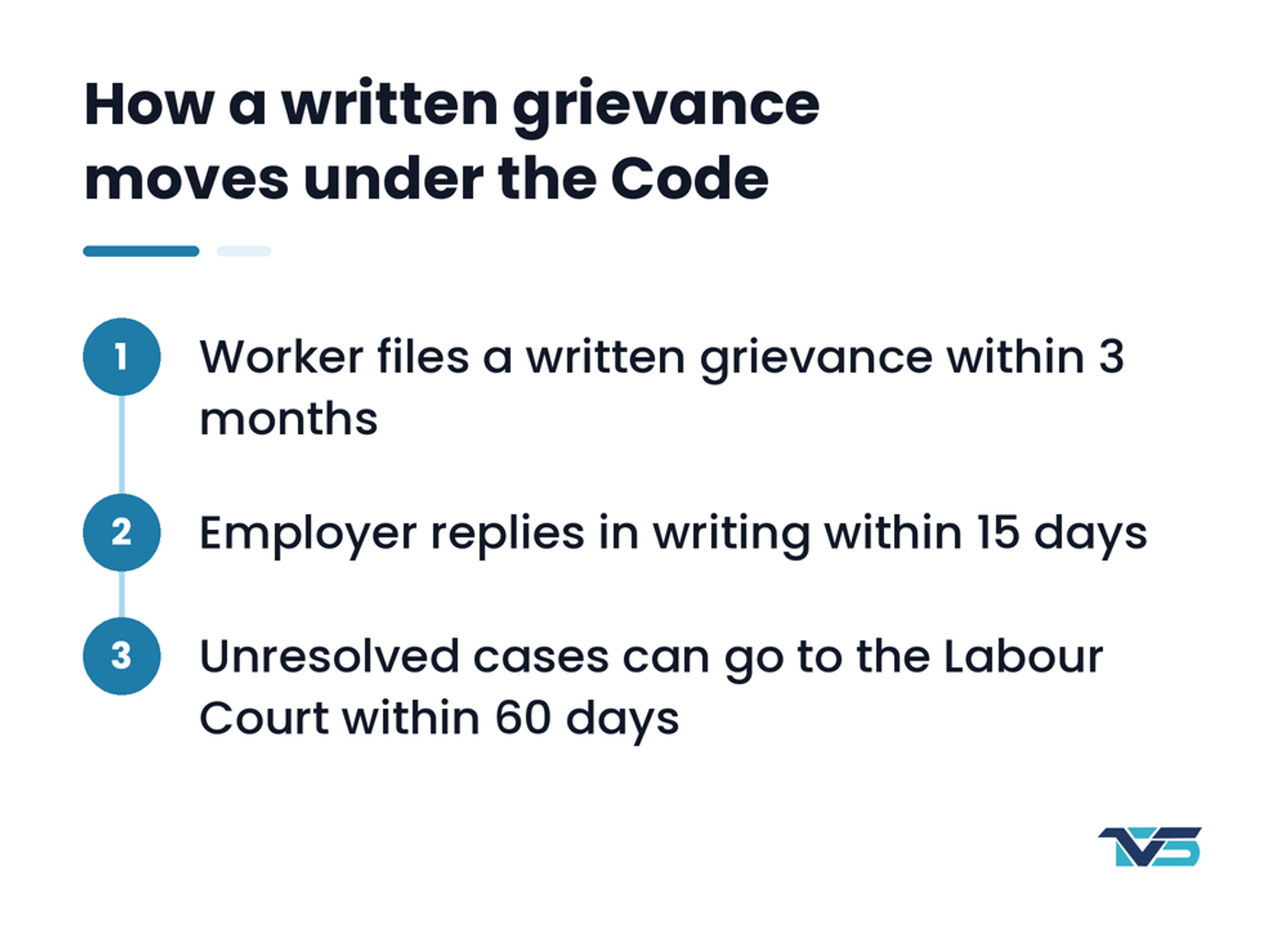
A worker can raise a written grievance, and the employer has a fixed time to answer. Pakera summarises the steps from section 335:
- The worker submits a written grievance within three months of the issue.
- The employer must reply within 15 days.
- If the matter is not settled, the worker can go to the Labour Court within 60 days after that.
The Express Tribune notes that the Punjab Labour Helpline (1314) also takes complaints, and that workers are advised to keep appointment letters, salary records, attendance and WhatsApp messages as evidence. Expect your records to be compared with theirs.
What records should employers keep?
Keep records that prove what you paid, when, for which days and hours, and under which written terms. ABS & Co says the Code requires "comprehensive employment records"; build each worker's file around what an inspector would ask for:
- signed appointment letter or agreement, in a language the worker understands;
- attendance and duty hours for every day, including overtime;
- monthly payslips showing gross pay, each deduction and net pay;
- leave applications, approvals and balances;
- salary transfers or signed cash receipts;
- written warnings, show-cause notices, grievance replies and termination letters.
If these sit in registers, Excel files and WhatsApp chats, see our guide on moving your business off Excel.
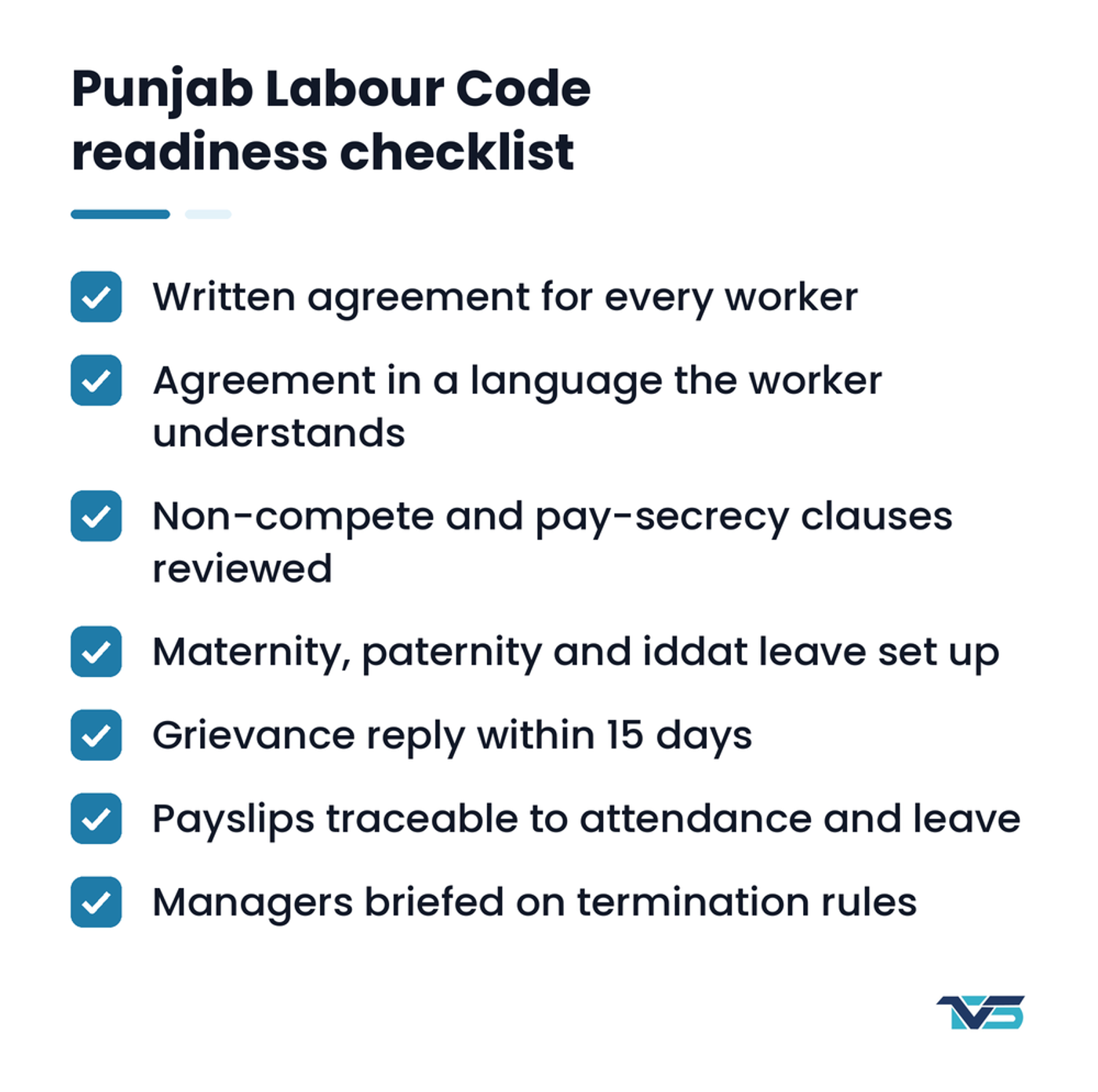
How should employers prepare? A 7-step checklist
Work through this in order:
- List everyone who works for you, including contract, part-time, agency and platform workers, and note who has no written agreement.
- Rewrite your appointment letter template to cover pay, working conditions, leave and termination, with an Urdu version where needed.
- Remove or narrow non-compete and pay-secrecy clauses after legal advice.
- Update leave types and policies: maternity, paternity and iddat as separate paid types, and check annual and sick leave against the Code's text.
- Write a grievance procedure with the 15-day reply deadline and a named person who receives grievances.
- Fix attendance and payroll records so every payslip can be traced to attendance, approved overtime and approved leave.
- Brief managers on non-discrimination, pregnancy protection and termination with valid cause, fair procedure and notice.
Payroll changes from the 2026-27 budget still apply alongside the Code; see payroll changes in Pakistan for 2026-27 for tax slabs and minimum wage floors.
How can HR software help with the Code?
Software does not make you compliant, but it keeps the records the Code relies on complete. Solvix HCM is an HR and payroll system for Pakistani employers, built by Tech Vision Solvix, that keeps employee records, attendance, leave, monthly payroll and payslips in one place.
For the Code, the useful parts are:
- Employment details and documents: joining date, employment type, probation end, confirmation and contract end dates, plus documents staff can view in their own portal, and a Contract Expiry Watchlist report.
- Leave types you define: paid or unpaid, gender-specific, encashable, document required after a number of days, with policies by grade, department or employment type and balances that accrue automatically.
- Payroll from attendance: absent, late and overtime amounts worked out from punches and shifts, with any admin override recorded with a reason.
- Payslips with every deduction on its own line, published to the employee portal, where staff tap "Received" so you can see who has acknowledged.
- Separation records (notice period, relieving letters, final settlement sheet) and an audit trail.
There are limits to know: tax, EOBI and PESSI are not calculated, gratuity is entered by hand in the final settlement sheet, and payslips are not sent by email or WhatsApp. If you also use biometric devices, the Attendance System sends punches into payroll live. For a wider comparison, read our HR software buyer's guide and payroll software guide.
Frequently asked questions
When did the Punjab Labour Code 2026 come into force?
The Code is Act IX of 2026 and received the Governor's assent on 10 February 2026. Dunya News reported on 29 May 2026 that it had been notified and applied across Punjab, but some legal summaries say they could not confirm the commencement notification, so check with the Punjab Labour Department.
Does the Punjab Labour Code apply to small businesses?
Yes. It covers offices, shops, factories, households and other workplaces, not only large factories. Section 434 lets the Chief Inspector reduce some entitlements for establishments with fewer than 20 workers, but no such reduction had been reported as notified by late October 2026.
How much maternity leave does the Punjab Labour Code give?
It gives 14 weeks at average monthly pay, 6 weeks before and 8 weeks after the birth, to a worker with at least six months' service. Extra leave applies for complications or a miscarriage, and the worker cannot be dismissed during pregnancy, leave or the four months after she returns.
Do contract workers get the same rights as permanent staff?
They get the same core protections. Fixed-term and agency arrangements are allowed only when they are genuine and time-bound, and labelling someone a contractor does not take them outside the Code.
Where can workers complain about unpaid salary in Punjab?
Workers can call the Punjab Labour Helpline on 1314 and file a written grievance with the employer, who must reply within 15 days. Unresolved cases can go to the Labour Court.
Get your records ready for the Code
The Code rewards employers who can show a written agreement, accurate attendance and a clear payslip for every worker. If your HR records still live in registers and spreadsheets, see how Solvix HCM keeps them in one system, or talk to our team about moving your staff records, leave policies and payroll over. This article is general information, not legal advice; confirm details with the Punjab Labour Department or a labour lawyer.