EOBI contribution for employers in Pakistan is 6% of the minimum wage for each insured worker every month: the employer pays 5% and deducts 1% from the worker's pay. It is a flat amount per worker, not a share of actual salary, and it applies to businesses with five or more employees. The hard part in 2026 is which minimum wage to use.
This guide covers who must register, how to work out the amount, why courts disagree on the wage base, and what records to keep so an EOBI demand never catches you without evidence.
Who has to pay EOBI contributions?
Any industrial or commercial business with five or more employees must register with the Employees' Old-Age Benefits Institution (EOBI) and pay contributions, and smaller businesses can register voluntarily, as an EOBI official explained to traders in Dawn. The scheme is large: EOBI has over 12.5 million registered people and about 850,000 beneficiaries, according to an EOBI briefing reported by Dawn in April 2026.
Coverage follows the business, not the job title. Office staff, factory workers, drivers, guards and shop staff all count toward the five-person threshold, so a growing SME often crosses it without noticing.
How is the EOBI contribution calculated?
The contribution is worked out per insured worker per month as a percentage of a wage base, not of the person's salary. A manager on Rs250,000 and a helper on the minimum wage cost the same in EOBI.
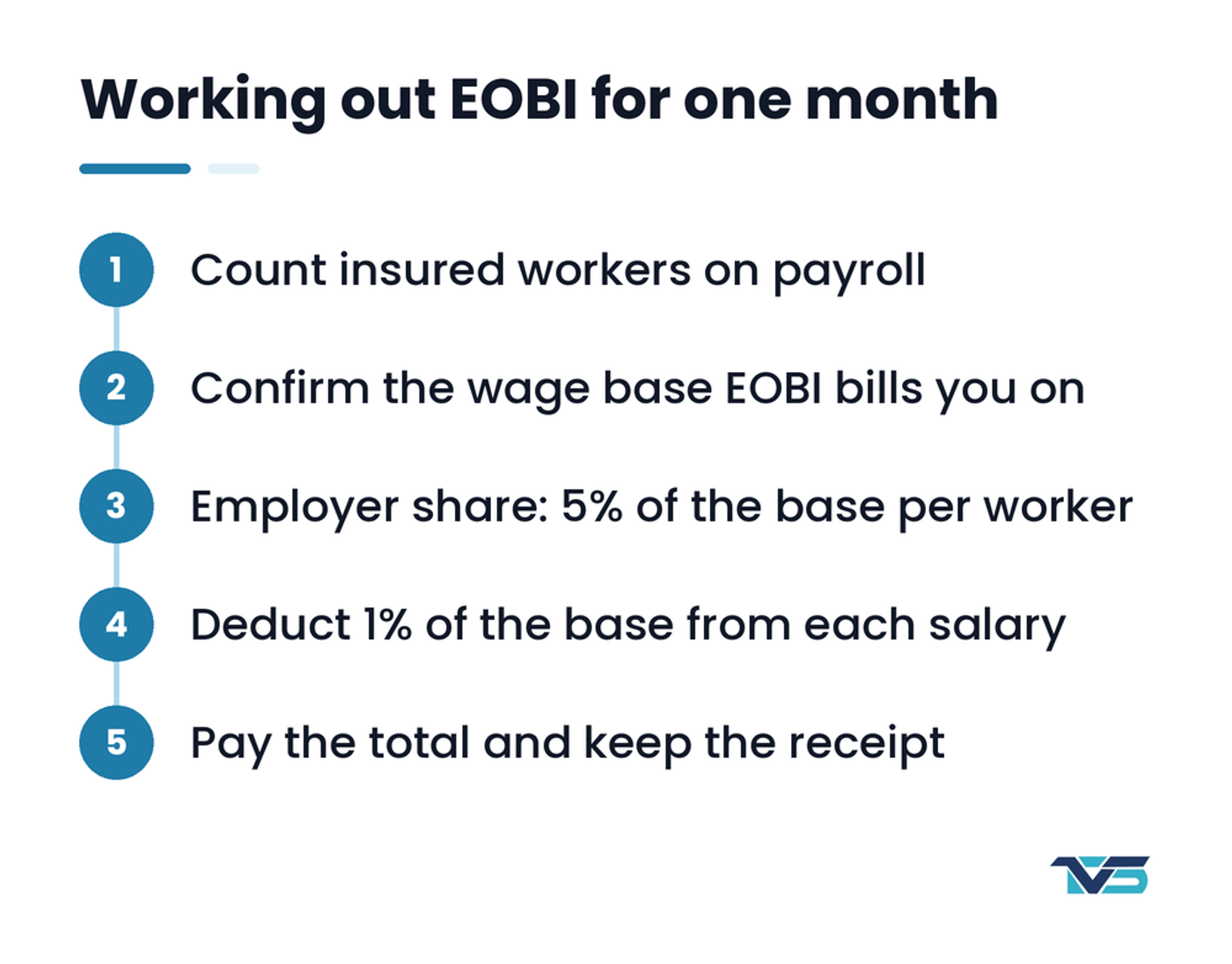
- Count every insured worker on payroll for the month.
- Pick the wage base your EOBI region is billing you on (see the next section).
- Employer share: 5% of that base for each worker.
- Employee share: 1% of that base, deducted from each worker's salary.
- Add both shares and pay the total against your EOBI challan.
Here is what one worker costs each month at the bases employers are paying on. The minimum wage figures are Islamabad's Rs40,700 and Sindh's Rs43,000 from 1 July 2026 (WageIndicator, ICT; WageIndicator, Sindh) and Rs40,000, the Punjab and KP wage for 2025-26 (Dawn).
| Wage base | Employer 5% | Worker 1% | Total per worker |
|---|---|---|---|
| Rs3,000 (Section 9 cap) | Rs150 | Rs30 | Rs180 |
| Rs40,000 | Rs2,000 | Rs400 | Rs2,400 |
| Rs40,700 (ICT 2026-27) | Rs2,035 | Rs407 | Rs2,442 |
| Rs43,000 (Sindh 2026-27) | Rs2,150 | Rs430 | Rs2,580 |
For a business with 20 insured workers, the gap between the lowest and highest rows is about Rs48,000 a month. That is why the wage base matters more than the percentage.
Why do employers pay different EOBI amounts?
Employers pay different amounts because courts have not agreed on the wage base. The EOBI Act, 1976 links "wages" to the minimum wage for unskilled workers, but a proviso in Section 9 says no contribution is payable on wages above Rs3,000, as an HR consultant set out in Dawn.
The same article records where the courts stand:
- The Supreme Court held in March 2021 that contributions follow the prevailing minimum wage for unskilled workers.
- The Lahore, Islamabad and Peshawar high courts later held that contributions are 6% of Rs3,000, including the worker's 1%.
- The Sindh and Balochistan high courts held that contributions are 6% of the prevailing minimum wage.
- Employers have appealed to the Supreme Court to settle the rate, and the dispute was unresolved when the article was written.
After the 18th Amendment, minimum wages are set province by province, so even "the minimum wage" can mean Rs40,000 in one province and Rs43,000 in another.
We found no EOBI notification from the last 30 days that changes the rate or base. Treat the table as a way to check your challan, not as legal advice. If your business is in a dispute, follow your lawyer and the court order that applies to you.
How does an employer register with EOBI?
Register the business first, then each worker, and do both within the period EOBI sets after you reach five employees. In practice this means:
- Register the establishment with your regional EOBI office or through EOBI's online services.
- Register each insured worker with their CNIC, date of birth and date of joining.
- Add new joiners in the month they join and report leavers when they go.
- Pay the monthly contribution against the challan EOBI issues, and keep each paid challan.
EOBI's own site did not respond when we checked it for this guide, so confirm the current forms and portal at your regional office. One 2026 employer guide puts the payment deadline at the 15th of the following month; check the date printed on your challan.
What records should you keep for EOBI?
Keep records that let you prove, month by month, who was employed, from which date, and what you paid. If EOBI ever questions your contributions, these papers are your answer.
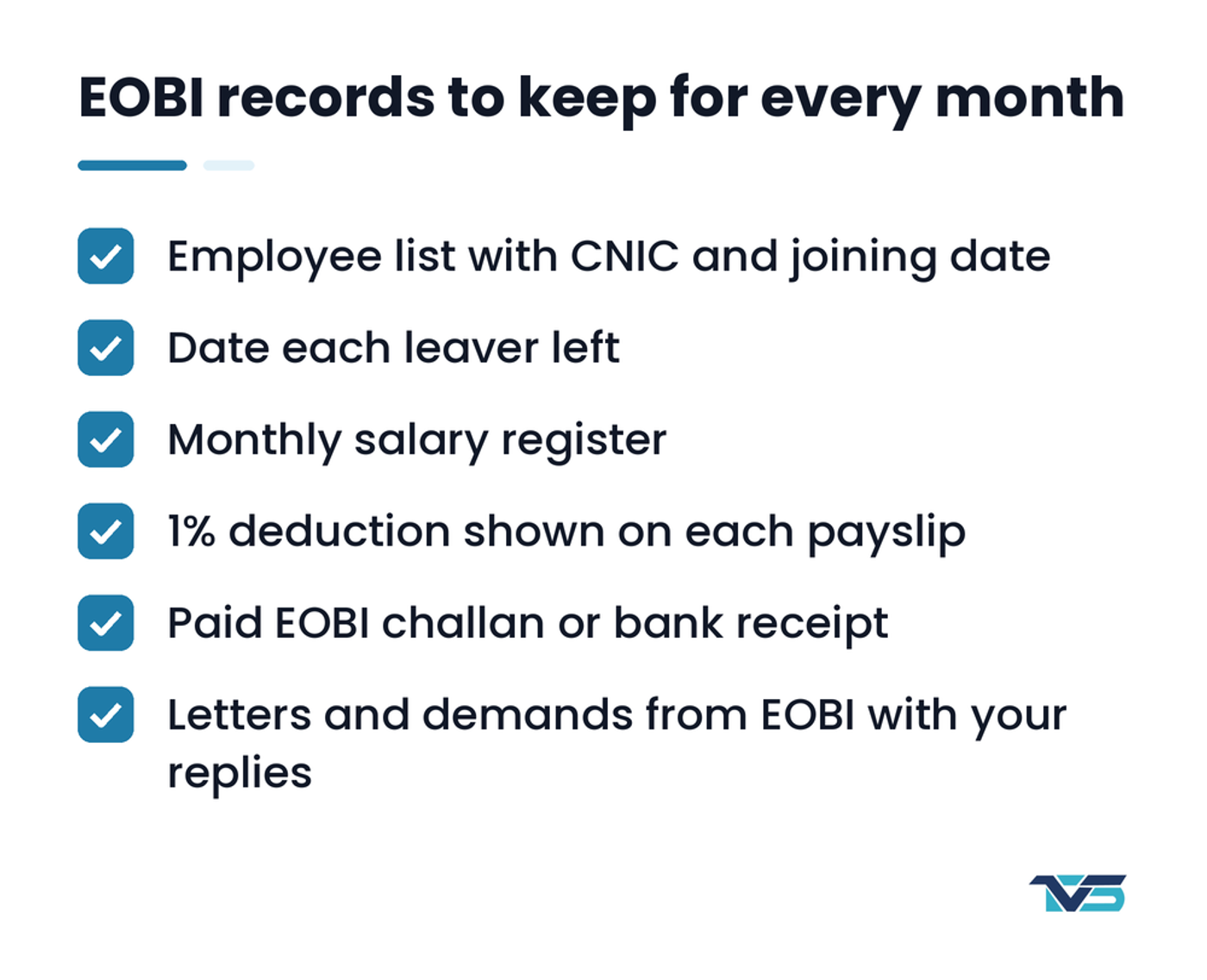
These records matter to your staff too. A worker needs 15 years of insurable employment for an old-age pension, and the Federal Constitutional Court ruled in January 2026 that 14.5 years or more counts as 15 (Dawn). The minimum pension is Rs11,500 a month, and EOBI has said claims should be settled within 45 days (Dawn). EOBI named missing records and closed employers as causes of delay, so clean records from you speed up a former worker's claim.
How is EOBI different from social security?
EOBI is a federal old-age pension scheme, while PESSI in Punjab and SESSI in Sindh are provincial social security schemes for medical and cash benefits. Many employers pay both, and they have separate rules.
| EOBI | Provincial social security (PESSI, SESSI) | |
|---|---|---|
| Purpose | Old-age pension, grants | Medical care, sickness and injury benefits |
| Run by | Federal institution | Provincial institutions |
| Base | Minimum wage (disputed) | Wage ceiling set by the province |
In Punjab, the labour department notified a social security wage ceiling of Rs40,000 a month in March 2026, and PESSI's commissioner said registered workers stay covered even when they earn more (Dawn). For the rest of this year's payroll changes, see our 2026-27 employer checklist, and for Punjab's new labour law, what the Punjab Labour Code 2026 changes.
How do you keep EOBI deductions right in payroll?
Keep EOBI deductions right by making the 1% a fixed line on every payslip, reconciling headcount with EOBI every month, and filing the paid challan with that month's payroll.
Solvix HCM is an HR and payroll system for Pakistani employers by Tech Vision Solvix. It keeps each employee's CNIC, joining date and transfers in one record, lets you add fixed deduction lines that show separately on each payslip, and produces a monthly salary register. It does not calculate EOBI or social security contributions or produce EOBI challans or reports, so you work out the amount and pay EOBI yourself. What it removes is the spreadsheet chase: one list of who was on payroll each month, matching what you report. See Solvix HCM, or read how to choose payroll software in Pakistan.
Frequently asked questions
What is the EOBI contribution rate for employers in 2026?
The employer pays 5% of the applicable minimum wage per insured worker each month, and deducts another 1% from the worker. The disputed part is the base: some high courts allow 6% of Rs3,000, others the prevailing minimum wage.
Is EOBI deducted from the employee's actual salary?
No. The worker's 1% is worked out on the wage base, not on actual salary, so every insured worker has the same deduction. The employer then deducts that fixed amount from the salary.
Do small businesses have to register with EOBI?
Businesses with five or more employees must register. A business with fewer staff can register voluntarily, which lets its workers build pension service from the start.
What should an employer do if EOBI sends a demand?
Check the demand against your own employee lists, salary registers and paid challans for the months it covers, and reply in writing. If you dispute the wage base used, take legal advice, because the courts have not settled it.
Can payroll software calculate EOBI automatically?
Some can; Solvix HCM does not. It records employees and lets you show the EOBI deduction as a fixed payslip line, but the contribution amount and the EOBI payment stay with you.
If you want employee records, attendance and payroll in one place so statutory payments are easier to check, talk to Tech Vision Solvix about Solvix HCM.