A hospital management system in Pakistan is software that runs a hospital's front desk, OPD, wards, lab, pharmacy and billing from one patient record instead of paper files and separate registers. For private hospitals in Punjab it is no longer optional: the Punjab Healthcare Commission has notified a mandatory HMIS for its largest category of private hospitals.
This guide is for owners, medical directors and administrators of private hospitals with wards, not single-doctor clinics. If you run an OPD-only practice, our clinic management software guide is the better starting point. Here we cover what the regulator now expects, which modules a hospital system needs, how vendors in Pakistan price it, and a test plan for your shortlist.
What has the Punjab Healthcare Commission made mandatory?
The Punjab Healthcare Commission (PHC) has notified the mandatory implementation of a Hospital Management Information System for all category-I private hospitals, moving them from paper-based records to digital service delivery, according to Pakistan Observer's report of 27 October 2025 and the PHC's own announcement. Category-I hospitals are those with more than 49 beds, as the PHC described them when it consulted on revised service standards in September 2025.
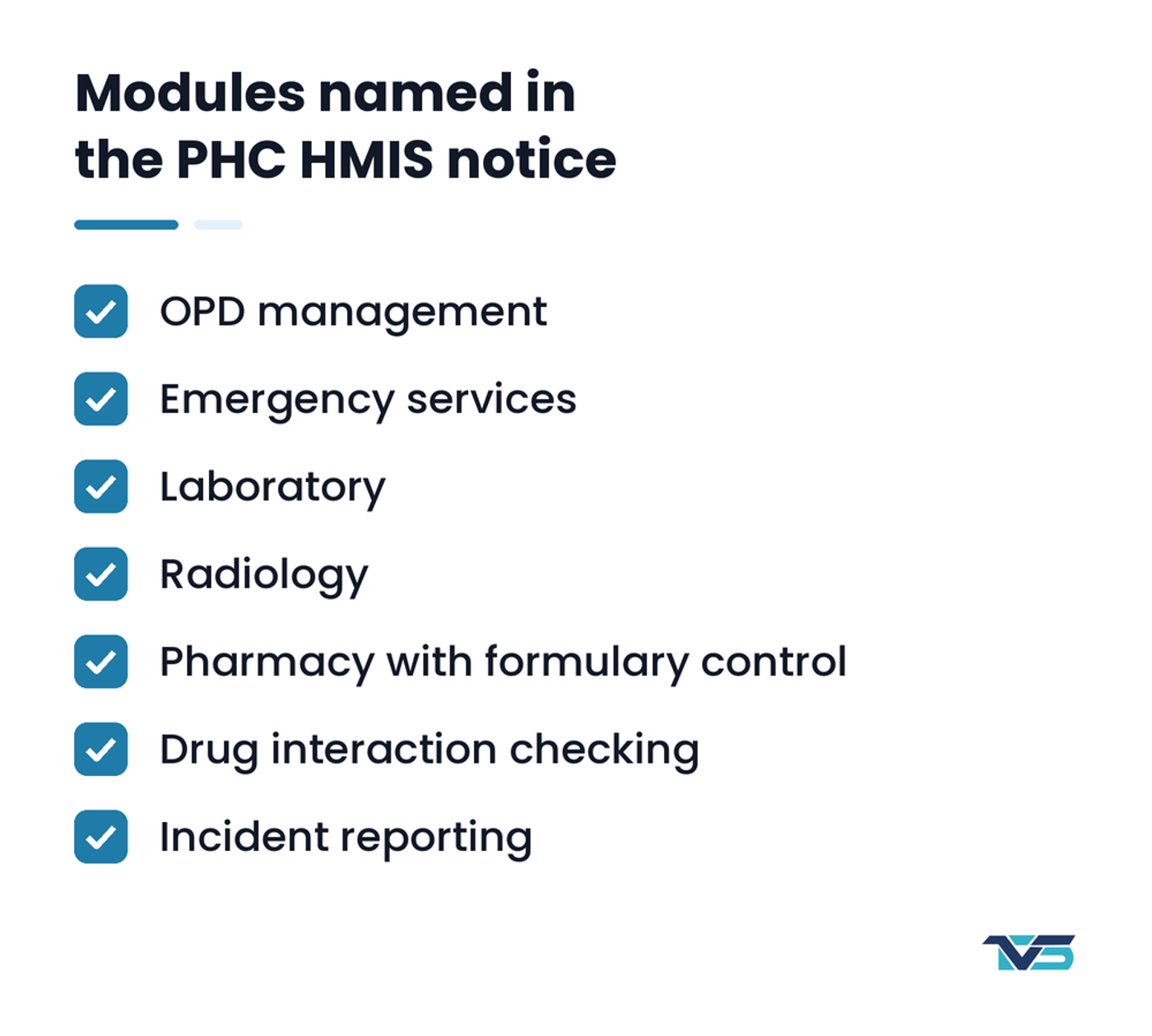
The report says the system integrates clinical, administrative and financial functions, will be rolled out in three phases, and will create real-time data links with the Commission's regulatory systems. The modules it names are:
- outpatient department (OPD) management
- emergency services
- laboratory
- radiology
- pharmacy, including formulary control and drug interaction checking
- incident reporting
Earlier, in a September 2025 letter reported by APP, the PHC said the "absence of a centralised patient record system remains a major hurdle" and urged the government to introduce a Universal Patient Medical Record Number so a patient's history can follow them across hospitals, labs and diagnostic centres.
The public reports do not give phase deadlines, and they do not make clear whether hospitals must use a system supplied by the PHC or can use their own software as long as it reports to the Commission. Before you sign with any vendor, ask the PHC in writing which applies to your hospital and what data format it expects.
Why do patient records matter at a PHC inspection?
Patient records are one of the first things inspectors check, and poor records are treated as a major violation. In September 2026 the PHC carried out 1,856 regulatory inspections across Punjab, including 109 hospitals, served 104 notices, suspended services at 36 facilities and sealed 4, Pakistan Observer reported on 2 October 2026. "Poor maintenance of patient records" was listed among the major violations, next to working beyond the scope of registration and missing qualified staff.
The same report lists expired medicines and reagents among the shortcomings found. A hospital system with batch and expiry tracking in the pharmacy and a lab test catalogue makes those checks routine rather than a scramble before an inspection.
Which modules does a private hospital actually need?
A private hospital needs every module that touches a patient between the front desk and discharge, connected to one patient ID. Use this table to map your departments to what you should see in a demo.
| Department | What the system should do | Ask in the demo |
|---|---|---|
| Front desk and OPD | Registration with CNIC, tokens per doctor, slips, vitals | Can two patients share one mobile number? |
| Doctors | Queue, visit history, digital prescription | Does the prescription print in Urdu? |
| Wards (IPD) | Admission, bed status, transfers, discharge summary | Show a transfer and a LAMA discharge |
| Operation theatre | Surgery schedule linked to the admission | Who can postpone a surgery? |
| Nursing | Vitals, medication record, handover notes | Is a missed dose recorded? |
| Laboratory | Orders, sample status, result entry, locked results | Who can change a finished result? |
| Pharmacy | Stock by batch and expiry, dispensing from prescriptions | Show items expiring in 30 days |
| Billing | Counter collection, invoices, partial payments, receipts | Can a receptionist mark a bill paid? |
| Management | Bed occupancy, revenue, doctor share, audit log | Show who edited a bill and when |
The PHC list adds two areas many local systems treat lightly: radiology (orders and reports, not just scanned files) and incident reporting. Ask each vendor directly whether they cover both, because a "yes" on a brochure often means an upload button.
How does hospital software pricing work in Pakistan?
Most vendors in Pakistan do not publish hospital software prices; they quote after a demo based on beds, modules and users. On the SoftwareSuggest list of hospital management software in Pakistan (updated 5 November 2026), 15 of the 20 products shown are "price on request". The few that show a price use different models: ETHER HIMS is listed at $22 per user per month and MEDICIN ERP at $167 for a single licence. Local vendor H-Cloud's hospital software page promises "transparent, predictable pricing" but shows no figures.
| Pricing model | How it is charged | Watch out for |
|---|---|---|
| Per user per month | Each staff login billed monthly | Nurses and front desk add up fast |
| One-time licence | Paid once, then yearly support | Upgrade and support fees later |
| Quote by hospital size | Based on beds and modules | Modules priced separately after go-live |
Whatever the model, get these in writing: which modules are included, the number of users, data migration from your old files, training, support hours, and who owns the data if you leave.
How do you choose a hospital management system?
Choose by testing your real workflows in a demo, not by counting features on a brochure. Run these steps with your shortlist of two or three vendors.
- Write down your departments and volumes: beds by ward type, daily OPD patients, lab tests, pharmacy sales, and how doctors are paid (salary or share).
- Confirm the PHC position: if you have more than 49 beds in Punjab, ask the PHC what the HMIS must report and by when.
- Run one patient end to end in each demo: registration, OPD slip, prescription, lab order, admission, transfer, discharge summary and final bill.
- Check access control: a receptionist should not be able to mark bills paid or change a locked lab result, and every edit should appear in an audit log.
- Test the printouts you use daily: thermal OPD slips, A4 prescriptions in Urdu, lab reports and discharge summaries on your letterhead.
- Ask about your gaps out loud: radiology, incident reporting, insurance claims, government health card panels and lab analyser links.
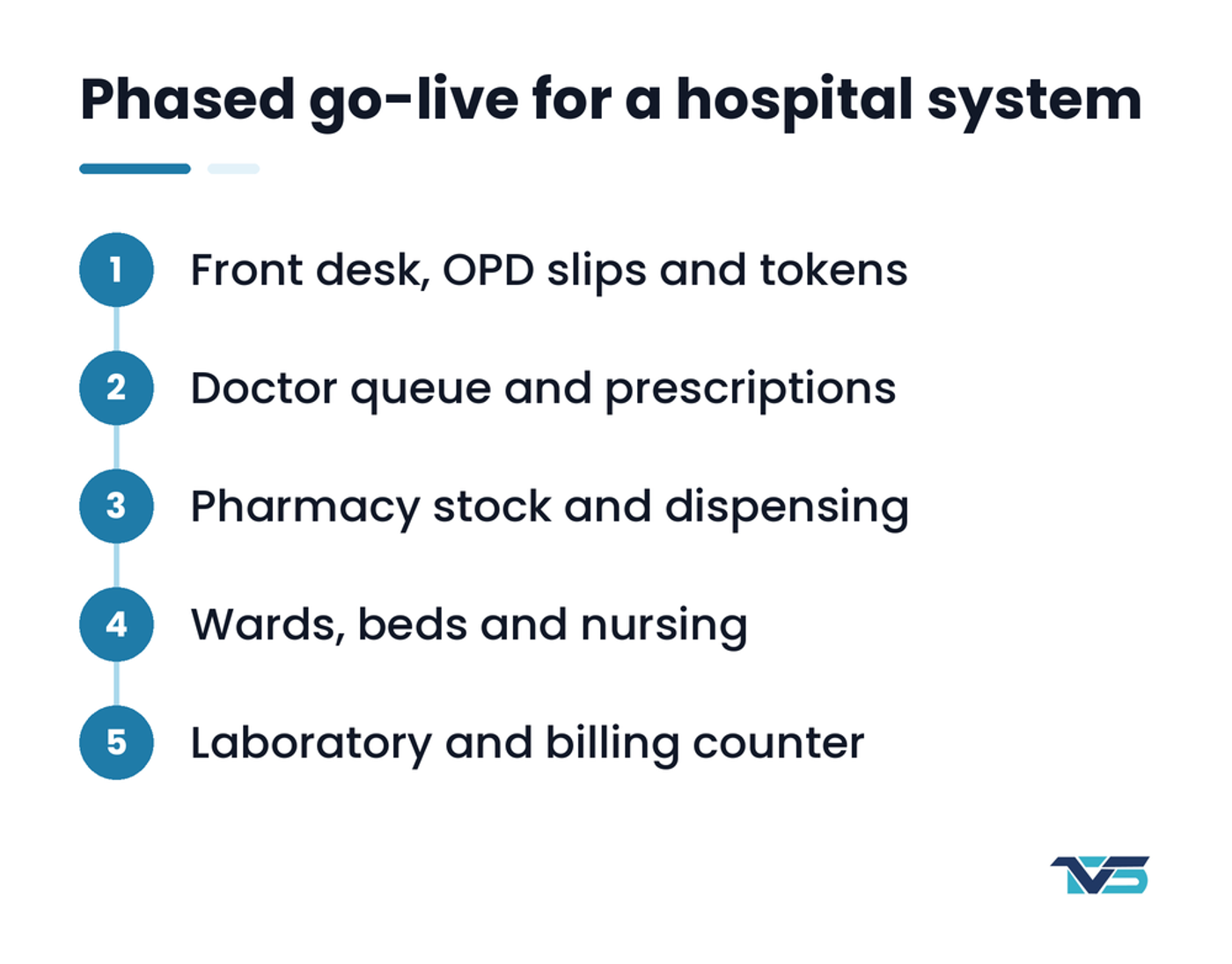
- Plan a phased go-live: start with front desk, OPD and pharmacy, then wards and lab, so staff learn one area at a time.
Keep paper registers running alongside the new system for the first weeks of each phase, and compare totals daily. The same approach works for any move away from files and spreadsheets, as we explain in moving your business off Excel.
Where does Solvix HMS fit, and what does it not do?
Solvix HMS is a hospital and clinic management system from Tech Vision Solvix, a Pakistani software company, covering the front desk, doctors, pharmacy, laboratory, inpatient wards and accounts in one web application. Its 22 modules can be switched on or off, so a hospital can run everything while a standalone pharmacy runs only its own module.
What it covers today:
- patient registration with CNIC and father or husband name, family grouping by shared mobile, and full patient history
- OPD and emergency slips with vitals, daily tokens per doctor, a waiting-area queue display, and A4 or 80 mm thermal printing
- IPD admissions with ward types (General to ICU, NICU and Maternity), bed status, transfers, LAMA and discharge summaries with ICD-10 codes
- operation theatre scheduling linked to admissions, nursing vitals, medication administration records and handover notes
- laboratory test catalogue with panels and normal ranges, sample status and locked results
- pharmacy stock by batch and expiry with 30-day expiry alerts, barcode sales and dispensing from prescriptions (see our pharmacy management software page)
- billing counter for slips, pharmacy and lab, invoices with partial payments, and cash, card, bank transfer, Easypaisa and JazzCash recorded as payment methods
- doctor share by OPD, emergency and IPD percentages, insurance company and claim records, role-based access and an audit log of edits
- English and Urdu interface, with Urdu prescriptions
What it does not do, so you can judge it against the PHC list:
- no radiology module: imaging reports can only be uploaded to the patient file
- no drug interaction checking or incident reporting module
- no link to PHC systems, Sehat Card or other government health cards
- no corporate or panel credit billing, no SMS or WhatsApp reminders, and no online payment gateway
- no lab analyser interfacing, and one installation serves one hospital, not a chain
Full details are on the Solvix HMS page. If your hospital also runs payroll on spreadsheets, our payroll software guide covers the staff side.
Frequently asked questions
Is a hospital management system mandatory in Punjab?
For category-I private hospitals, those with more than 49 beds, the Punjab Healthcare Commission notified a mandatory HMIS in October 2025, to be rolled out in three phases. Public reports do not give phase deadlines, so confirm your hospital's timeline with the PHC.
What is the difference between clinic and hospital management software?
Clinic software mainly handles OPD: registration, appointments, prescriptions and billing. Hospital software adds inpatient wards and beds, operation theatre, nursing records, laboratory and pharmacy stock, all linked to one patient record from admission to discharge.
How much does a hospital management system cost in Pakistan?
Most Pakistani vendors quote after a demo instead of publishing prices; on SoftwareSuggest's Pakistan list, 15 of 20 hospital products are "price on request". Prices depend on beds, modules and users, so compare quotes on the same written scope.
Can a hospital system work in Urdu?
Some can. Ask to see the Urdu screen and a printed Urdu prescription in the demo, because many systems only translate menus. Solvix HMS has an English and Urdu interface and prints Urdu on prescriptions.
How long does it take to move a hospital onto software?
It depends on the number of departments and the data you bring across. Going live one area at a time, starting with the front desk and OPD, lets staff learn without stopping patient care and keeps paper as a fallback.
If you are planning your hospital's move to software or preparing for the PHC requirement, talk to Tech Vision Solvix for a demo of Solvix HMS on your own workflows.